

King Sorrow: Review & Analysis
A Faustian Dragon tale for our times

“All Hail the King”
Where do you start with a tome like this? Straightforwardly, I suppose.
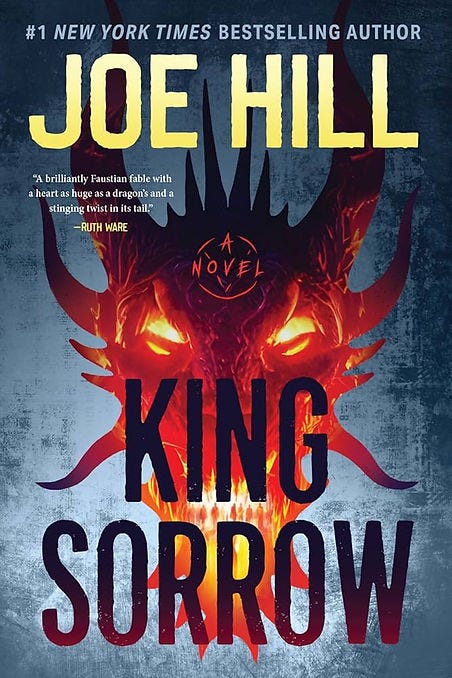
King Sorrow (2025) by Joe Hill is a 897-page work of horror/fantasy – that genre descriptor being conveyed quite effectively at even a first glance by the dragon’s head adorning the cover, featuring both a bloody pentagram on its forehead and a crowd of figures illuminated in its fiery maw.
I want to spoil as little as possible in this top section, partly because the journey of discovery about this book’s scope and subject matter was so rewarding for me.
On the other hand, I think it’s fair to discuss a little of the book’s background and influences – mostly in hopes that it will convince more folks to give the book a shot. Though he writes under a pen name in order to work, live and succeed outside his father’s shadow, Joe Hill was born Joseph Hillström King, to a certain Stephen King.
And I don’t bring that connection up to pad word count or idly gossip: in many ways, King Sorrow is a heartfelt tribute to Stephen King’s life work. Hill includes easter eggs large and small to King’s books – the main one I noticed, as a moderately knowledgeable fan at best, being to The Gunslinger.
But I also found that this felt like a King novel, both structurally and thematically, while also standing magnificently as its own work. I’ve written before about my favourite King stories, The Shining and Doctor Sleep, and I deeply appreciate how King Sorrow likewise explores characters’ journeys and relationships with alcohol – a topic of extreme importance to King.
But without further ado let’s jump into the meat of the book. As always, consider checking it out for yourself before proceeding! Spoilers ahead.
Raising the Stakes
King Sorrow follows a group of six characters: Arthur Oakes, Colin Wren, twins Donovan (Van) and Donna McBride, Allison (Allie) Shiner and Gwen Underfoot. The six become attached while the former five are students at the fictional Rackham College, with Gwen being the daughter of Colin’s family’s caretaker who joins and befriends them.
The premise is simple enough to begin. Arthur’s mother, Erin Oakes, is serving a sentence for manslaughter – having tried to save the life of an injured officer while trespassing in a pacifist protest. Jayne Nighswander, daughter of Erin’s fellow inmate Daphne Nighswander, begins threatening Erin’s life in order to have Arthur steal rare books for her from Rackham’s library.
This escalates until Arthur is forced to steal the grim and mysterious Crane Journal, around the same time a public confrontation finally has him bringing his friends in on the situation. Before turning the Journal over to Jayne, the group spends an alcohol- and marijuana-filled day reading the text, and by evening have decided to attempt a ritual it describes: to summon and bargain with the dragon King Sorrow. (Reminiscent of scenes in The Secret History and The Magicians, and certainly symbolic of addled bad ideas the world over.)
The ritual is fantastic and fantastical, and the audiobook narrator makes a wonderful meal out of every single line from the dragon. Ultimately, the group succeeds in sending King Sorrow after Jayne Nighswander and her boyfriend, with the agreement that someone has to die on Easter morning, no matter what. Days later, they realize this was not in fact a drug-induced hallucination, and eventually attempt to warn Jayne and Ronnie into fleeing.
Working together the group easily and deftly overpower Jayne and Ronnie and give them the bare facts. Although the book doesn’t say it outright, it’s tragic to see how easily the problem could’ve been solved without them employing the nuclear option.
Not that the warning matters; Jayne roasts and Ronnie is chewed into a dozen pieces. Then, the following year, King Sorrow returns to ask who’ll be dying this Easter. And thus the Faustian tragedy truly begins to unfold.
It’s funny to look back at my early thoughts on the book, imagining Jayne and Ronnie as the main antagonists rather than the pitiful victims of the book’s prelude; imagining the setting would stay confined to Rackham College in the 1980s. Not so much. In fact, every time I thought I had a grasp on King Sorrow‘s scope, I was pages away from having the rug pulled out from under me.
That’s as much linear plot as I’ve got room for, though I’ll reference plenty of later events and themes as I get into analyzing King Sorrow‘s characters and morals below. As a matter of fact, I’ve only spoiled as much as the back of the book does so far – a fair example of why I try to never read those.

Test of Character
King Sorrow begins with Arthur’s point-of-view, but eventually expands to give each of the six significant time in the spotlight – both to follow their current narrative and to get a closer, personal look at important moments in their pasts.
Arthur himself is pretty much a good guy, though not someone to go out of his way to find a perfect solution when a simpler, decent one is put before him. Thus, stealing the books, summoning the dragon, and later continually agreeing with Colin’s picks for King Sorrow’s targets. I love that Arthur goes on to be a professor and to uncover other supernatural aspects of the world, I love his self-help/activism book on modern dragon-slaying, and I deeply appreciate seeing a Black character as the book’s primary protagonist. Other than an awkward early intimate scene which is more fully explained much later, he’s the simple and likeable rock upon which the story is founded.
Colin is pretty much everything wrong with the world. The wealthy one of the group, Colin is easily the most interested in King Sorrow from the moment he gets his hands on the Crane Journal. After Jayne’s death and while the rest are still coming to terms with their guilt, he begins researching and suggesting individuals from among the most evil in the world to send King Sorrow after each year. Over the decades of the book’s story, he becomes a billionaire tech CEO and it’s revealed that some of his targets were slightly more personal – wiping out the competition – than he led his friends to believe. An essential contrast between Arthur and Colin is their polar opposite views of technology, which Joe Hill sets up and pays off very well, painful as it may be.
Donovan is another good guy, and mostly a balancing weight for his twin. Big spoilers: He dies first, and honestly his loss feels significantly more important than his presence did.
Donna is forever scarred from watching a friend be abducted as a child. Her survivor’s guilt long ago became infected with xenophobic rage, leading her to express wildly conservative views early in the book and later become a literal Fox News anchor. When rifts begin to form in the group, she is swayed to Colin’s side by horrible lies that nonetheless match her paranoid and hateful worldview. It’s Donna who most memorably says “All Hail the King”, because unlike Colin’s calculations and schemes, Donna just loves that King Sorrow makes her imagined enemies burn.
Allison hurts, y’all. She’s lesbian, and was sent to conversion therapy in her teens where she was sexually assaulted and told that her attraction to women was a form of self-punishment – a horrible ‘lesson’ she spends most of the book believing. In love with Donna, who later uses this to manipulate her awfully, and in a messy relationship with Donovan, she takes up the bottle early and struggles with alcoholism for a long time. Thankfully (and all but uniquely among the cast), she finds happiness and self-redemption toward the end.
Gwen’s great where Arthur’s good, having immense empathy and going out of her way to improve people’s lives. Guilty about her role in bringing King Sorrow into the world and the lives he takes, Gwen becomes a paramedic and saves thousands – though of course it’s never enough. She picks up main protagonist duties from Arthur at a certain point and it works wonderfully.

Morals & Morality
King Sorrow‘s epilogue all but breaks the fourth wall in coming out and saying that the eponymous dragon is a metaphor for American drone strikes and ideas of preventative killings in general. Gwen and Robin (a wonderful trans woman who joins the cast about halfway through the book) continue to watch cataclysmic fires unfolding even after King Sorrow has been dealt with, and realize that theirs wasn’t the only dragon in the world.
It feels to me as though Hill added that scene (markedly in 2022) out of frustration with current events and a desire to have King Sorrow make a lasting impression on readers. On the other hand, Colin’s character has become far more real since 2022 with the rise of Peter Thiel and Palantir. How different is a malevolent dragon from an AI?
The characters of King Sorrow spend a lot of time considering the ramifications of their actions, and Joe Hill does a great job tying it all into real historical events. As with real life, how many new threats are created every time one is preventatively eliminated?
In addition to the book’s exploration of homophobia, alcoholism, manipulation, transphobia, racism, online (and literal) trolls, the nature of power and so much more, it offers a reminder that we’re all ultimately human. Allison and later even hate-spewing Donna ultimately find themselves and course correct. Colin’s obsession with power and control consume him in the end, but in his final moments we see the terrified boy underneath the facade.

From the Heart
I loved this book, and I find it abundantly clear that Joe Hill does too. A few other highlights, then a couple critiques, then I’ll say farewell.
I really enjoyed Daphne Nighswander’s interludes, a shot fired at the group from almost the beginning of the novel and which only hits them near the end. All the dragon and other fantasy stuff was excellent, as were the important supporting characters like Robin, Erin, Tana and Llewellyn. It’s fascinating that drinking King Sorrow’s tears is described as such a pleasant death, one’s soul igniting – listen to today’s song above which I think is a great fit!(There’s certainly more, but only so much time and space.)
Critiques (all framed by more positives apparently):
while it’s fantastic to have the final confrontation be all women up against the dragon, I found the sudden emphasis on so much witty banter between them a little jarring
I loved the idea of the government coming in and trying to first eliminate, then harness King Sorrow for themselves, and their sudden kidnapping of the McBrides – but hard to believe they really just gave up and walked away forever after Easter
the group all have tattoos that let them summon King Sorrow in self-defense, and it comes with a price of rapidly aging them (very cool!) except Allie uses it a bunch to avoid capture and we never see it affecting her?
King Sorrow is a highlight of King Sorrow, go figure. The nightmares Jayne experiences are simply incredible – especially being broadcast into Arthur and Gwen’s heads as they are. Sadly, that aspect of him rarely comes up later on, even when one of the main characters becomes his new target! I was missing him for quite a while in the last chunk of the book, though he’s great in the final confrontation of course.
Anywho. My longest article in a while, perhaps ever, for a long and spectacular novel. Give it a read if you’re able and interested! For now, I return to the Long Dark to dream of fire.
Thanks for reading and until next time <3