

There Is No Antimemetics Division: Review & Analysis
A requiem for the forgotten

On Wings of Merit
Like so much of the entertainment industry, publishing has been known to play favourites with the types of authors and stories it highlights, preferring safe bets on familiar genres. Romantasy, YA dystopias, what have you.
There Is No Antimemetics Division took a very different path to recognition. Written and posted online in installments between 2015 and 2020 as part of the SCP collaborative writing project and fandom, most would immediately assume it has no place as a physical novel – let alone one picked up for publication by Penguin Random House.
But it can happen! As with Alchemised, which recently saw traditional publication with its Harry Potter fanfic serial numbers filed off, there is apparently real room for works to escape the purgatory that is online fanfic writing – provided the demand and/or merit is there. And I was incredibly impressed by this one!
I recently read qntm’s independently published version of the book, complete with references to the SCP Foundation, and that’s the one I’ll be referencing today. (If you’ve read the new version, Marion Wheeler = Marie Quinn and Bart Hughes = Ed Hix.)
Spoilers ahead. As always, I highly recommend taking a look yourself first! Otherwise, let’s dig in.
Antimemetics
The key idea of this book is the Antimemetics Division; part of a greater, secretive Foundation whose goal is to protect humanity from things we don’t understand. The Antimemetics Division deals with phenomena which are impossible to remember, to various degrees and specifics.
Whether you know anything about the SCP fandom or not, the baseline idea of cataloguing and tracking entities you can’t remember probably sounds like a challenge. And it is! The novel does a great job of introducing these ideas gradually through a few specific cases before adding layers of complexity and existential stakes into the mix.
In addition to training and keen minds, the Antimemetics Division leverages drugs to enhance the memory and perception of its employees. Yet as is demonstrated throughout the novel, it takes only a fractional slip-up or a moderate external nudge to lose the memories of half your career and be required to rebuild from scratch.
The book (mostly) follows protagonist Marion Wheeler, Director of Site 41 and Chief of the Antimemetics Division, as she confronts various antimemetic threats and slowly uncovers imminent, world-ending catastrophe.

It’s incredibly fascinating to me that many of the vignettes in the first half of the book are simply about the Division itself: whether Marion explaining it to others or researching it herself. We quickly learn that history in Marion’s world is fragile and fleeting, that any consistent sense of self for her, the Division or humanity at large is at best a haphazard construction based on whatever shreds of information have yet to be forgotten.
Well, surely then the existential threat is one which will wipe away all human memory? The reason so much history is lost is that it’s already got its hooks in? Not in this book, anyway.
The book never spells it out plainly, but the importance of the Antimemetics Division in this case is to combat the existence of a hyper-memetic idea/entity in the form of SCP-3125. It is a mind-virus you contract the moment you think of it, and the book pulls no punches in demonstrating how quickly it spreads once it gets going.
Thus Marion (and the Division) spend the novel fighting a war they don’t remember 99% of the time, with the exception of secure rooms (from which no data or memories can leave) and moments of horrifying revelation which must likewise be instantly erased to prevent catastrophe.
Miraculously, this story crammed to bursting with fascinating science fiction ideas also manages to pull off a half-decent relationship story between Marion and her forgotten, presumed-dead husband Adam. His introduction halfway through the book is immediately up there on the list of all-time greats, and though he plays a huge role in saving the world, qntm ensures he is heroic and likeable in very different ways to Marion. Not overshadowing, but coloring in the gaps.

Unrecognized & Forgotten Heroes
I’m sure there are multiple meanings and morals to be pulled from this text, though more than with any other work I question whether the author intended them or they simply arise from the ideas at play here. Believe it or not, my first instinct was mindfulness: that we’re better off perceiving and tending to the present than dwelling in past or future. But even I can admit that we’ve maybe covered that topic enough in the past year.
Instead, I want to focus on the title and its reverberations throughout the book. There Is No Antimemetics Division: because they’ve erased themselves from existence at least twice in order to save the planet from SCP-3125, or because they’ve erased our memory of them, or because you’re their boss and want to conveniently forget about needing to pay them.(Again, this is the stuff SFF dreams are made of. I love the concepts in here so much, and the title brings them together perfectly.)
The other direction this got me thinking in is about the invisible work that saves millions of lives each year, though we’ll never know it. Watch this segment from Brennan Lee Mulligan on Ask Hank Anything if you have a moment! But essentially, the work that science and engineering, even in fields far away from health care, have done that regularly and passively save lives. It will never be remarked upon; the chain of cause and effect is rarely even perceivable; yet you and I are alive because of it.
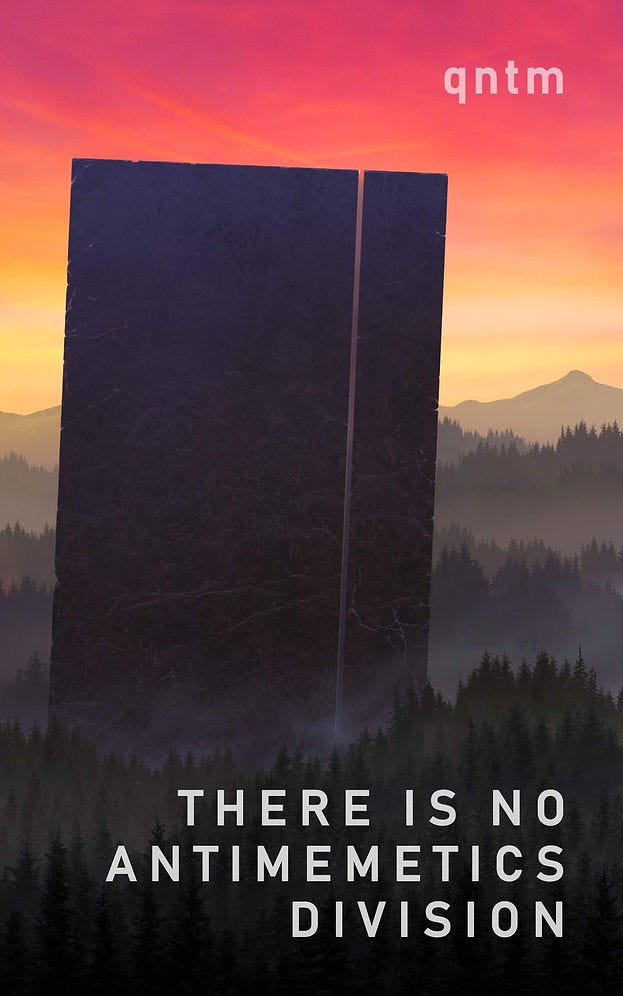
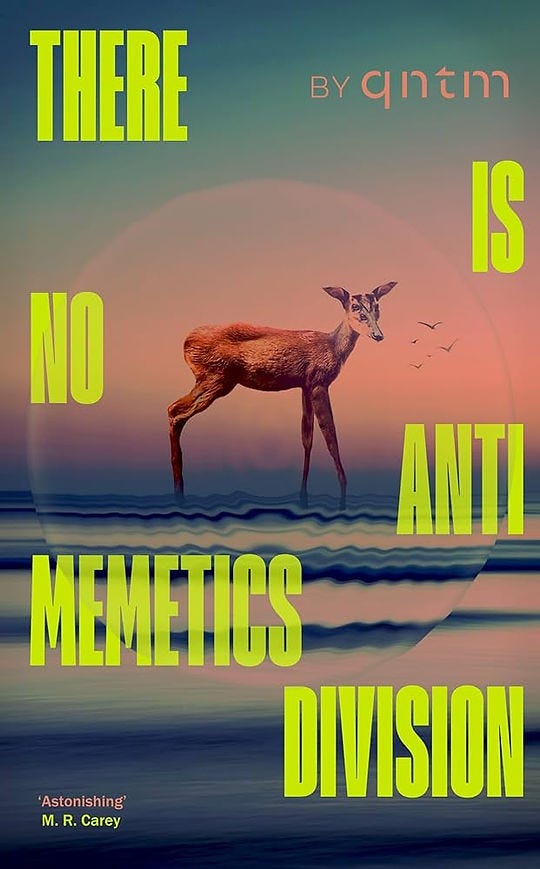
On the book’s original cover is an alien monolith, all that meaningfully remains of a prior human civilization. On the new cover is a Cryptomorpha gigantes, a species of miles-tall megafauna with antimemetic properties which play a significant role in saving our species.
So, what I take from this book (alongside a deep appreciation for its ideas) is an overwhelming gratitude for the forgotten. Those who came before us, those here alongside us, those who will save our lives in ten years even though no one will ever know it.
(On the other hand, There Is No Antimemetics Division, that we know of. How scared should we be, of self-concealing ideas and entities?)
Apologies
... for the blank post. I meant to review a book today, but I’m having the hardest time remembering what it was. I already did The Devils and On the Calculation of Volume, right?
Well, if you can somehow think of it, I highly recommend seeking it out! I think, anyway.
What I do remember is I spent hours today engrossed in We Used To Live Here by Marcus Kliewer and am enjoying it greatly as a mashup of House of Leaves, Haunting of Hill House and I’m Thinking of Ending Things. Here’s to hoping the final third doesn’t suck!
Thanks for reading and until next time <3